
Fighting off the AI bubble

Updated: Jul 18
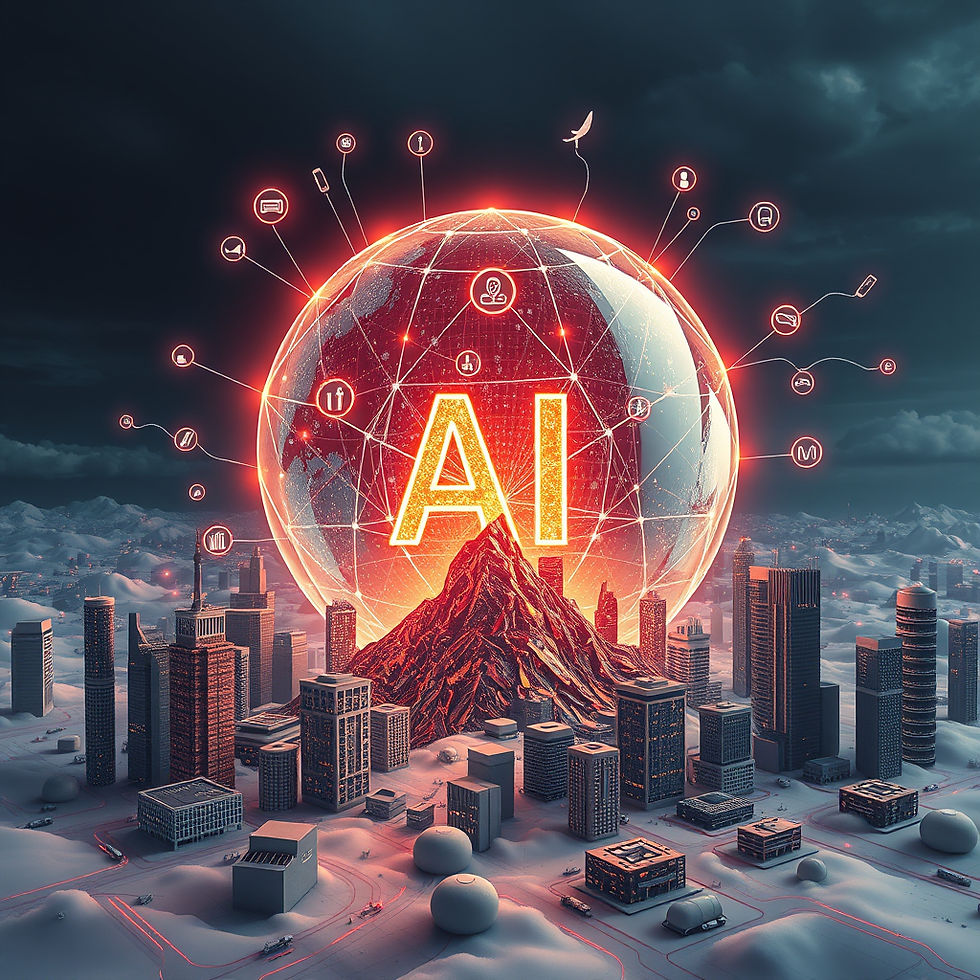
The next recession may be because of AI bubble but may not begin because AI failed.
It may begin because companies bought AI faster than they redesigned themselves to use it.
In 2025, investors poured approximately $202.3 billion, or €177.4 billion, into AI companies.
AI absorbed almost 50% of all global startup funding.
Global startup investment reached roughly $425 billion, or €372.6 billion, across more than 24,000 companies.
Meanwhile, annual SaaS spending was projected to approach $294 billion, or €257.8 billion.
The promise was irresistible:
More productivity.Fewer employees.Faster decisions.Lower operating costs.Scalable intelligence. Exponential returns.
But the economy does not run on software demonstrations.
It runs on semiconductor fabs, aircraft factories, energy systems, laboratories, warehouses, machine tools, qualification programmes, maintenance networks and physical supply chains.
And physical value creation is brutally expensive.
Intel recorded approximately $18.4 billion, or €16.1 billion, in annual R&D and administrative operating expenses in 2025, while targeting around $18 billion, or €15.8 billion, of gross capital expenditure.
TSMC is planning approximately $52–56 billion, or €45.6–49.1 billion, of capital expenditure in 2026.
Airbus generated €73.4 billion, or $83.7 billion, in revenue in 2025, but carried an implied operating cost base of roughly €67.3 billion, or $76.8 billion, before interest and tax. Its R&D expense alone was €3.15 billion, or $3.60 billion.
This is where the SaaS narrative becomes uncomfortable.
A consumer can download an application and begin using it within minutes.
A large industrial company cannot.
In B2B industry, software must pass through:
Engineering structures.Manufacturing processes.Cybersecurity requirements.Quality systems.Export controls.Legacy ERP, PLM and MES landscapes.Supplier contracts.Programme governance.Regulatory approval.Human incentives.Budget ownership.And several layers of management defending several versions of reality.
The software may work perfectly.
The organisation may still fail to produce value from it.
Research from MIT’s NANDA initiative examined billions of dollars in enterprise generative-AI investment and reported that approximately 95% of studied pilots produced no measurable P&L impact.
Productiv previously found that 53% of SaaS licences went unused in its dataset.
Flexera reported in 2025 that only 43% of organisations had complete visibility across their technology stack.
This is not primarily a software problem.
It is an architecture problem.
Large companies continue to buy digital tools as isolated solutions:
One tool for engineering.Another for procurement.Another for programmes.Another for finance.Another for manufacturing.Another AI assistant for everybody.
Each business case promises a return.
But nobody architects the complete path through which that return must travel.
So the licence is purchased.
The pilot is celebrated.
The dashboard is launched.
The organisation continues working through spreadsheets, email chains, local databases, unofficial meetings and human interpreters.
The expected return quietly evaporates.
Multiply that pattern across thousands of companies, while capital floods into increasingly similar AI products, and the macroeconomic risk becomes visible:
Investment rises. Valuations rise. Infrastructure debt rises. Software expenditure rises. But enterprise productivity does not rise at the same speed.
That gap is where bubbles acquire gravity.
AI does not need fewer architects.
It needs architecture more than any technology before it.
Silk Route of Systems works at that missing layer.
We connect enterprise strategy, engineering, manufacturing, supply chain, information systems, governance and financial outcomes into one operating architecture.
Not another tool.
Not another dashboard.
Not another pilot.
A structure through which existing technologies can finally produce the value that was promised.
The companies that win the AI era will not be those that buy the most software.
They will be those that redesign the enterprise so value can flow through it.
It may begin because companies bought AI faster than they redesigned themselves to use it.