
Addressing Misalignment in Capital Equipment Industries: A Wake-Up Call for Executives

Intended audience
Mergers and Acquisition firms who focusses on aerospace, automotive, semiconductor and energy industries. You will learn how to make sure that the initial investment on the purchased companies can be enriched through developing the supply chain architecture of the conglomerate and then you will also learn how an enterprise architecture connecting the operations to the market strategy would increase profits and then of course how a data architecture would connect a set of branches to the headquarters, seamlessly.
Executives of large conglomerates who are looking for an architecture to connect all of their daughter companies together.
Executives of large corporations who are looking to increase the overall value of their organisation
Executives of small medium enterprises who are looking to expand their supplier network and gain value through a shared network.
The Aerospace landscape
Understanding Melrose requires grasping the ecosystem it operates in. Aerospace is often associated with manufacturers like Airbus and Boeing, but behind them are different types of owners.
Not all owners create value similarly. Some are large industrial conglomerates, benefiting from scale and diversified portfolios. Others are specialist investment firms focused on strengthening operations and increasing value.
Melrose belongs to a third group that buys complexity. It specializes in transforming underperforming industrial businesses through restructuring and operational improvements, exemplified by its acquisition of GKN Aerospace.
Long-term strategic investors and sovereign wealth funds focus on industrial capability and long-term growth.
While any organization can acquire an aerospace company, the real challenge lies in post-acquisition transformation. Success depends on operational integration, aligning engineering with manufacturing, and evolving organizational structures without disrupting long-lasting products.
This highlights the importance of enterprise and supply chain architecture in mergers and acquisitions, as they determine if promised value is realized. Melrose serves as a case study, demonstrating success through integration and continuous improvement of complex industrial enterprises.
The Enterprise Symptom Catalogue
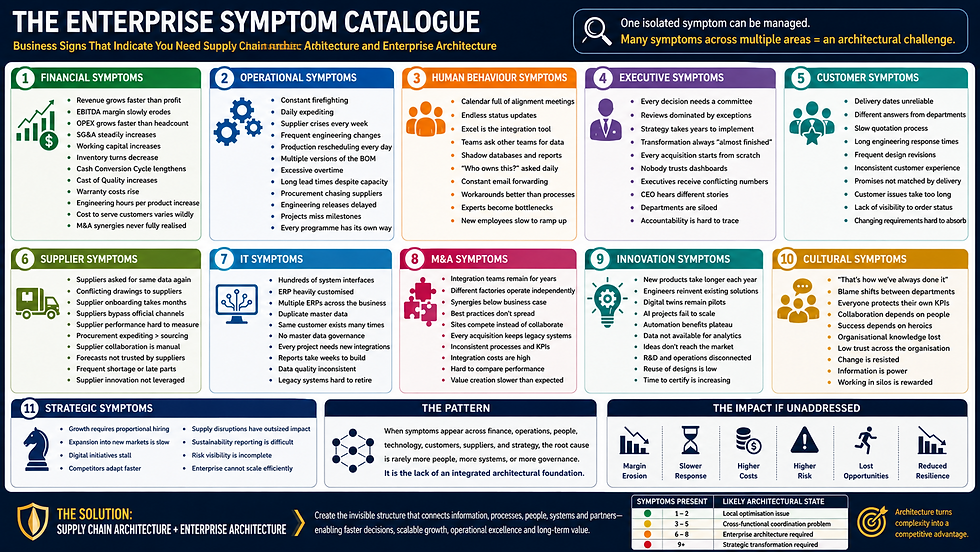
Nobody says,"We need Enterprise Architecture."
Instead they say,
"Why are we firefighting every week?"
"Why is working capital increasing?"
"Why do acquisitions never deliver the expected synergies?"
"Why does every important decision require another meeting?"
Those questions are symptoms.
This slide groups those symptoms into eleven areas.
Finance.Operations.People.Executives.Customers.Suppliers.Technology.Mergers and acquisitions.Innovation.Culture.Strategy.
Notice something important.
Every department believes it has its own problem.
Finance sees shrinking margins.
Operations sees unstable schedules.
Engineering sees constant design changes.
Procurement sees supplier issues.
IT sees disconnected systems.
HR sees collaboration problems.
Each function is correct.
But each is looking at the organisation through its own window.
Architecture asks a different question.
What single structural problem could create all of these symptoms at the same time?
That is why this catalogue exists.
Not to diagnose departments.
To diagnose the enterprise.
Now I'd like you to look at the bottom right corner.
This may be the smallest box on the slide...
but it's probably the most important.
It translates symptoms into architectural maturity.
If you observe one or two symptoms, you're probably dealing with a local optimisation problem.
Perhaps a single process is broken.Perhaps one department needs attention.
That doesn't require an enterprise-wide transformation.
But once you start seeing three to five symptoms appearing across different functions, something changes.
You're no longer looking at isolated issues.
You're looking at a cross-functional coordination problem.
Departments are beginning to work against each other rather than with each other.
When the organisation reaches six to eight symptoms, the architecture itself has become the constraint.
The business is spending increasing amounts of energy simply coordinating itself.
At this stage, Enterprise Architecture is no longer a "nice to have."
It becomes a business necessity.
And finally...
when nine or more symptom groups are present, you're no longer fixing isolated problems.
You're leading a strategic transformation.
Because by then, finance, engineering, procurement, manufacturing, IT, programme management, suppliers and customers are all experiencing different manifestations of the same underlying structural issue.
This diagnostic model is important because it changes the conversation.
Instead of asking,
"Which department should we fix?"
executives begin asking,
"What is it about the way our enterprise is designed that allows all of these symptoms to exist simultaneously?"
That is the moment architecture moves from being an IT discipline...
to becoming a business strategy.
The pattern is remarkably consistent.
When information moves slowly...people compensate.
When processes don't connect...departments compensate.
When systems don't integrate...Excel compensates.
When governance becomes unclear...meetings compensate.
The organisation continues operating.
But it becomes increasingly expensive to coordinate.
And those coordination costs eventually appear everywhere.
In the P&L.
In delivery performance.
In employee frustration.
In customer experience.
And ultimately...
in shareholder value.
Enterprise Architecture is not about documentation.
Supply Chain Architecture is not about logistics.
Together, they define how information, decisions, materials, responsibilities and value flow across the entire business.
When that architecture is healthy, most of these symptoms disappear naturally.
When it isn't...
every department ends up treating symptoms instead of solving the disease.
Health scan for your organisation
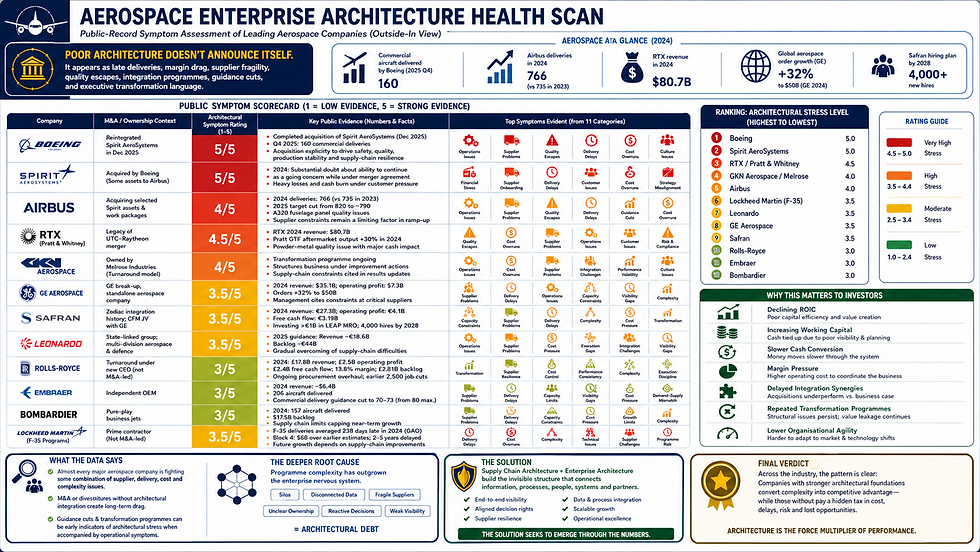
This slide is information-dense, so let me explain it. It measures something not in financial statements: Architectural stress.
Every enterprise has two balance sheets: the financial one with revenue, profit, and cash flow, and the architectural one, which isn't published but inferred from signals like transformation programs and supplier recovery initiatives. These collectively show how hard an organization works to coordinate itself, which this scorecard measures.
Demand isn't the issue for aerospace companies like Airbus, RTX, and Safran. They face operational challenges like supplier instability and production constraints, despite strong demand. This slide assesses companies using public information, not to judge them but to show how much effort is spent managing complexity. It measures stress on the enterprise system, not products.
Boeing's production and certification issues, Airbus's supplier capacity limits, and RTX's metallurgy problem illustrate coordination challenges. GKN Aerospace's focus on transformation signals adapting to complexity. Most companies score above three, indicating industry-wide complexity, not isolated issues. The competitive advantage now lies in coordinating enterprises, not just product design.
On the right, architecture impacts finance. There's no "architectural debt" line, but its effects are visible: lower returns, higher working capital, and margin pressure. Finance shows what happened; architecture explains why. The slide's central message is that program complexity exceeds the enterprise's capacity to manage it, resulting in architectural debt, which compounds through coordination burdens.
The solution isn't another transformation program but building architecture that supports successful transformations. Enterprise and Supply Chain Architecture connect information, processes, and people into a cohesive model, reducing friction and leveraging growth.
This infographic isn't ranking companies but highlighting a new way to interpret organizational signals. Recognizing architectural signals changes how annual reports are read, revealing enterprise health. It raises the question: Why do some companies face higher architectural stress? To answer, we must examine their business models, especially those growing through mergers and acquisitions.
What various organisations claim and what the publicly available outcomes show
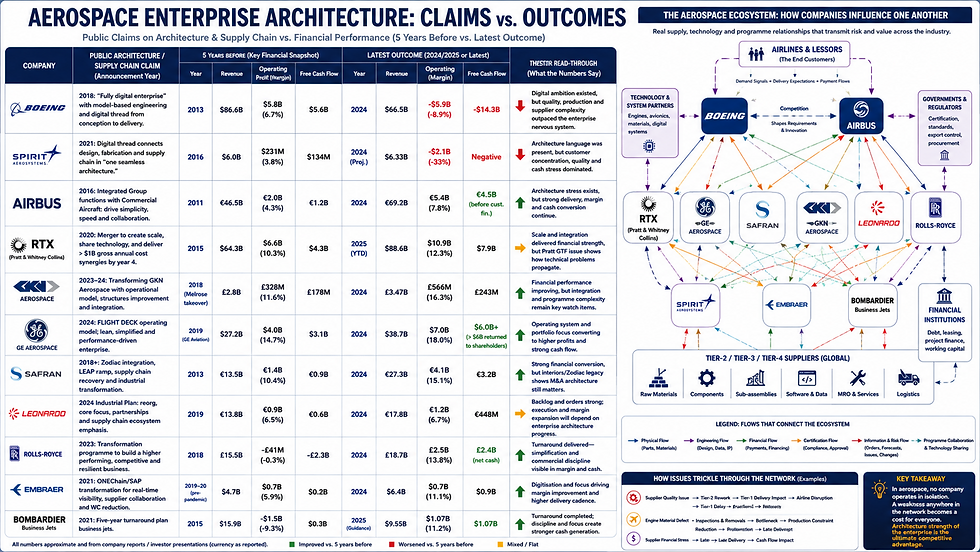
The previous slide questioned whether architecture matters, but this slide poses a more uncomfortable question:
Can we actually see architecture working?
Over the last decade, major aerospace companies have launched initiatives like Enterprise Architecture and Digital Engineering. Annual reports promise integration, visibility, and simplification, but the real question is:
"Which organisations have turned these architectural ambitions into measurable business performance?"
The table on the left compares the financial position before and after major architectural announcements, focusing on revenue, operating margin, and free cash flow—business outcomes, not architecture metrics. The architectural read-through reveals what the numbers indicate, not management claims.
Some organisations, like GE Aerospace, Rolls-Royce, Safran, and Airbus, improved margins and operational discipline, showing architecture as an economic asset. Others, like Boeing, faced coordination failures despite ambitious initiatives. RTX's merger succeeded financially, but a metallurgy issue highlighted systemic risks. Architecture reduces complexity but doesn't eliminate risk, impacting resilience during crises.
The aerospace industry functions as a network, not isolated firms. Every decision affects the entire system, and disruptions propagate across the network, as seen with Spirit AeroSystems and Pratt & Whitney.
Competitive advantage now depends on superior coordination across engineering, manufacturing, procurement, and finance. Architecture enables this coordination, raising the question: who sees the whole system? Leadership holds this responsibility, as executive decisions shape the operating environment. Quality visibility leads to anticipation, resilience, and competitive advantage.
This perspective explains the existence of the Silk Route of Systems. Traditional disciplines like Enterprise Architecture and Supply Chain Architecture often work in parallel. The goal is to connect them into a single analytical framework, termed Enterprise Systems Intelligence, understanding how various factors interact to determine performance.
With this in mind, let's examine our case study: Melrose Industries and its transformation of GKN Aerospace, illustrating these principles in action.